
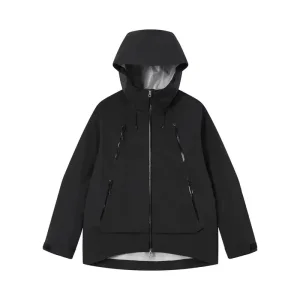
Pre-tested OEM and ODM membrane-bonded jackets, active hybrids, and precision-quilted outerwear configurations ready for enterprise customisation.
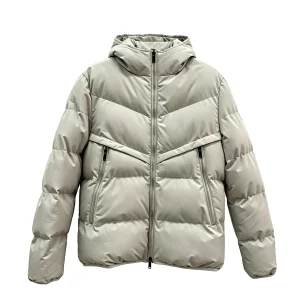
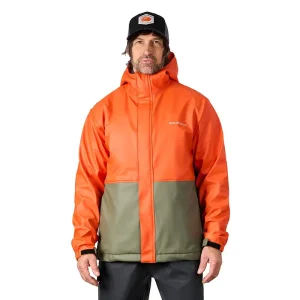
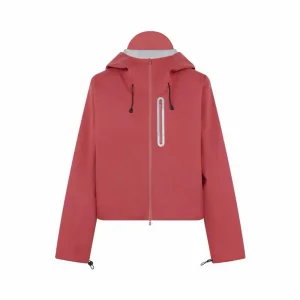
Understanding shifting consumer purchasing profiles, institutional procurement standards, and the industrial synthesis of city transit gear with technical alpine shells.
Today’s high-density commuter demands jackets that bridge wet weather resilience with corporate-level minimalist design. The traditional bulky polyurethane raincoat has been replaced by sub-280-gram silhouetted garments featuring 2.5-layer hydrophilic polyurethane or ePTFE laminations. Urban cyclists and underground subway navigators require low bulk, noiseless mechanical stretch face textiles, and rapid self-stowage capability into integrated internal packs without sacrificing 10,000mm water barrier ratings.
Manufacturers are migrating alpine-grade expedition technologies straight into street-level tech packs. This cross-pollination means city commuters leverage jackets featuring underarm micro-perforation venting, storm cuffs with integrated thumb loops, three-point storm hood cord locks designed for bike helmets, and water-repellent AquaGuard® reverse-coil zipper placements engineered to survive harsh freezing horizontal rains and prolonged squalls.
Global procurement teams have moved past spot-market transactional buying toward direct strategic manufacturer alliances. Sourcing directors require Tier-1 certified factories offering vertically synchronized production: in-house CAD patterning, high-speed automated laser cutters, pneumatic Hot-Air Seam Sealing platforms, and strictly mapped supply chains operating under OEKO-TEX® Standard 100 and bluesign® chemical management accreditations.
A comparative structural analysis of industrial membranes, weight classes, and testing requirements utilized across premier OEM production runs.
| Layer Architecture | Membrane Polymer Matrix | Hydrostatic Head (ISO 811) | MVTR Breathability (JIS L1099 B1) | Base Fabric Weight | Optimal Commercial Application |
|---|---|---|---|---|---|
| 2.5-Layer Ultralight | Hydrophilic Polyurethane (PU) + Carbon Print | 10,000 – 15,000 mm | 15,000 – 18,000 g/m²/24h | 58 – 75 gsm (15D–20D Ripstop) | High-Density Urban Commuting & Compact Travel Shells |
| 3-Layer Performance Shell | Microporous ePTFE (Bicomponent) | 20,000 – 28,000 mm | 20,000 – 25,000 g/m²/24h | 85 – 120 gsm (30D–40D Cordura® Nylon) | High-Altitude Alpine Treks, Heavy Snow & Mountaineering |
| 3-Layer Circular Mono-Material | Recycled Thermoplastic Polyurethane (rTPU) | 12,000 – 15,000 mm | 12,000 – 15,000 g/m²/24h | 80 – 95 gsm (Recycled Polyester) | Closed-Loop Sustainable Corporate Outerwear Collections |
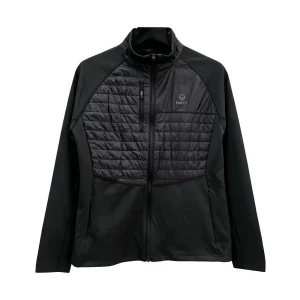
| Hybrid Softshell/Puffer | DWR 4-Way Stretch Face + Synthetic Insulation | 5,000 – 8,000 mm | 8,000 – 10,000 g/m²/24h | 140 – 210 gsm (75D Mechanical Stretch) | Sub-Zero City Street Wear & Winter Field Operations |
From micro-tape bonding to automated pressure chambers, how top-tier manufacturers eliminate seam leakage and premature delamination.
Traditional technical jackets utilize wide 20mm or 22mm hot-melt sealing tape, adding excess mass, stiffness, and heat-loss zones. Elite outerwear factories implement calibrated 11mm to 13mm three-layer micro-seam bonding machines running at 400°C–420°C with automated feed synchronization. This eliminates edge curling, reduces garment weight by up to 18%, and preserves soft textile drape without compromising wet-burst strength under 50 kPa water pressure.
Manual die-cutting introduces dimensional discrepancies of up to ±3mm across multilayer fabrics, which can destroy the integrity of precision articulated elbows and waterproof front fly plackets. Our industrial partners utilize continuous multi-head CNC laser tables equipped with optical distortion correction. Panels are cut with sealed, anti-fray borders within a tolerance of ±0.2mm, allowing instant transfer to computerized stitching workstations.
Quality reliability cannot rely solely on post-production visual audits. Factory quality control incorporates continuous Suter-style hydrostatic test cells operating on every 500-meter textile roll prior to spreading. During line assembly, random garment seam joints are pulled and subjected to 3-bar hydrostatic pressures for 180 seconds, ensuring that stitch perforations, adhesive resins, and backing scrims hold zero water ingress across 10,000 continuous flex cycles.
Optimizing functional shell design parameters according to real-world regional microclimates and specific end-user demands.
Subjected to high-volume coastal rainfall, moderate wind chilling, and high ambient humidity. The jacket requires non-swelling PFC-free C0 durable water repellent (DWR) surface finishes, heavy-gauge storm plackets, and 3-way adjustable hoods engineered to channel driving rain away from the face. Ventilation through two-way pit zips is critical to prevent condensation build-up inside the shell during fast-paced pedestrian commuting.
Requires instantaneous thermal modulation. Users alternate between freezing outdoor street winds and heated train carriages or indoor retail centers. Key engineering highlights include featherweight packable 15-denier ripstop outers, stealth-matte finishes without typical outdoor fabric rustling, discrete interior device pockets with internal earphone cord routes, and reflective 3M Scotchlite™ piping for night-time cycling safety.
Demands abrasive durability against granite rock faces, heavy pack straps, and sleet-mixed blizzards. In this scenario, high-tenacity 40D/70D Cordura® reinforced panels are mapped onto the shoulders, elbows, and hip belt zones. The interior must feature a low-friction tricot backer that slides effortlessly over mid-layer fleeces and down insulation coats without friction piling.
Strategic milestones guiding the next era of smart membranes, circular polymer chemistry, and low-emissions garment construction.
Universal elimination of long-chain and short-chain fluorochemicals across wholesale lines. Deployment of bio-based dendrimer and silicon-derived hydrophobic matrixes that withstand 30+ industrial wash cycles while maintaining a spray rating of 90/100.
Elimination of mixed-material laminates that hinder textile-to-textile recycling. Development of completely pure polyethylene terephthalate (rPET) or thermoplastic polyurethane (TPU) garments—including face fabric, membrane, seam tape, and zipper teeth.
Commercial scaling of electrospun polyolefin membranes offering true air permeability (0.1–0.5 CFM). This delivers continuous vapor release without requiring the internal microclimate to overheat before wicking commences, providing superior comfort for high-output urban running.
Direct integration of printed graphene thermal heating tracks and Bluetooth-connected environmental sensors into inner shell layers, automatically moderating microclimate warmth without adding unyielding bulk or compromising waterproof seam seal arrays.
A systematic OEM/ODM verification blueprint for retail brand founders, product managers, and corporate buyers sourcing high-spec performance jackets.
Prevent production drift by defining exact tolerances in the initial RFQ. Tech packs must specify: target Denier (D) count, fabric weight (gsm), lamination type (PU/ePTFE/TPU), hydrostatic head thresholds (ISO 811), MVTR testing standards (JIS L1099 method A1 or B1), zipper brand and tooth type, seam tape width and thickness, and precise bar-tack positions on load-bearing cord exits.
When selecting manufacturing partners, verify on-site specialized machinery rather than standard cut-and-sew lines. Essential hardware includes: computerized seam-sealing machines with automatic tension regulators, ultrasonic welding units for bonding pocket edges, hot-melt film laminating presses, and hydrostatic head burst testers located directly inside the factory laboratory.
Performance membranes typically involve high mill dye minimums (1,000–1,500 meters per colorway). To navigate this challenge, brands can adopt common base-color fabrics (matte black, asphalt slate, slate navy) across multiple SKUs, leveraging contrast laser-bonded trims, custom pullers, and distinct silkscreen branding to differentiate styles without violating raw material minimums.
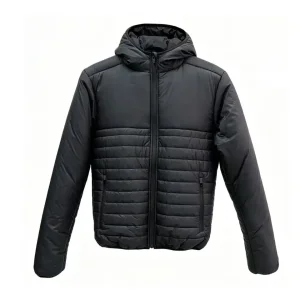
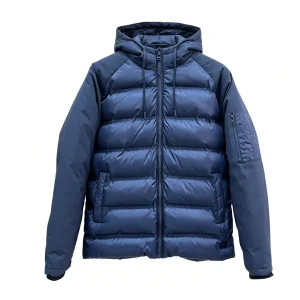
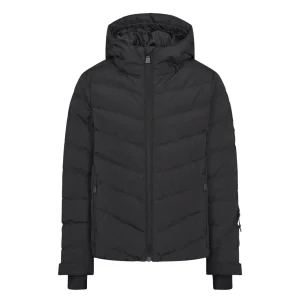
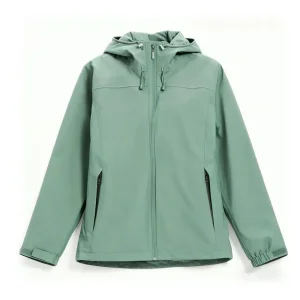
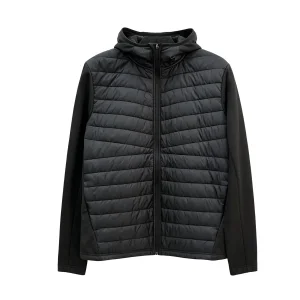
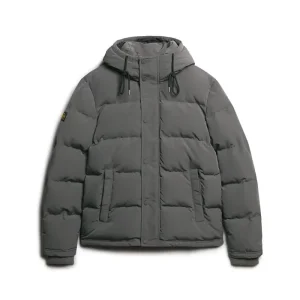
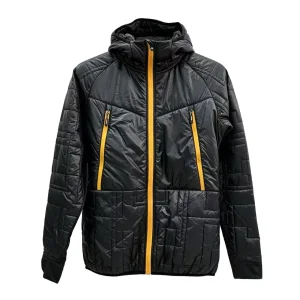
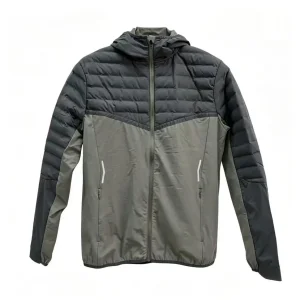
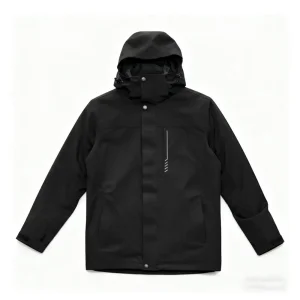
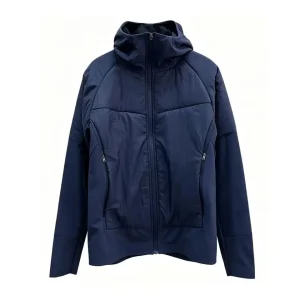
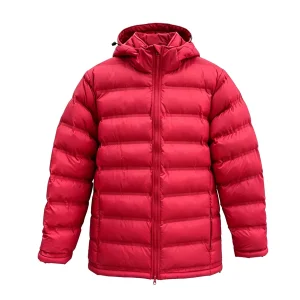
Explore heavy-duty windproof coats, modular commuters, thermal puffer designs, and chevron-quilted winter protection developed under rigorous factory controls.
Direct technical answers addressing production lead times, lab dip approvals, hydrostatic ratings, and custom hardware tolerances.
A 2.5-layer shell bonds a high-tenacity face textile directly to a waterproof membrane, finished internally with an ultra-thin raised dry-touch carbon print (the half-layer) to protect the PU from abrasion and body oils. A 3-layer laminate features an actual knit or woven scrim backing laminated directly to the membrane. While 2.5L is significantly lighter, packable, and cost-effective for city commuters, 3L offers superior abrasion resistance, seam-burst longevity, and comfort during long-term alpine expeditions.
Our manufacturing audit utilizes strict AQL 2.5 guidelines paired with in-house laboratory equipment. Taped seam sections undergo testing using an ISO 811 hydrostatic head tester, maintaining no leakage at 10,000mm+ water column pressure. Additionally, seam samples undergo Martindale 10,000-cycle abrasion checks and 5x continuous industrial washing cycles at 40°C to verify zero seam edge-peeling, bubbling, or polymer adhesive embrittlement.
Standard proto sampling requires 7 to 12 working days following tech pack receipt and pattern digitization. Fabric lab dips and trim strike-offs take approximately 10 to 14 days. Once pre-production samples (PPS) are formally approved and raw materials arrive at the cutting floor, bulk production lines run at 35 to 45 calendar days depending on seam complexity and order volume. Expedited sampling lanes are available for established OEM program partners.
Yes. We accommodate full brand customization down to the hardware components. We regularly incorporate authentic YKK® AquaGuard® waterproof zippers, customized matte electroplated zinc alloy pullers with engraved debossed logos, laser-etched Cohaesive™ embedded internal cord lock adjusters, and high-visibility hypalon zipper garages. All hardware selections undergo salt-spray corrosion tests for 48 hours to prevent oxidation in marine and wet-street environments.
In saturated urban environments where external air humidity is high, moisture-vapor transfer (MVTR) slows down because vapor pressure differentials equalize. To overcome this physical limitation, we incorporate mechanical venting designs alongside microporous membranes: concealed vertical torso zips, laser-drilled underarm breather portals, and back-yoke chimney vents lined with ultra-breathable open mesh. This ensures continuous convective airflow even when atmospheric rain saturates the face textile.
Our manufacturing partners adhere to international labor and chemical governance frameworks. Production facilities hold BSCI (Business Social Compliance Initiative) and SEDEX SMETA 4-pillar audits, verifying ethical working standards and safety. Material sourcing complies with OEKO-TEX® Standard 100 Class II (contact with skin), and all surface waterproofing chemistries comply with REACH Annex XVII and ZDHC (Zero Discharge of Hazardous Chemicals) MRSL regulations.